
Loading...
Profile

Food Technology

Accreditation: UNGGUL

The Food Technology Study Program (TP) is one of the study programs at the Faculty of Halal Food Science (FIPHAL) at Djuanda University (UNIDA), which was established in 1988. By 2025, the Food Technology Program has been accredited by BAN-PT with the rating of “Excellent” based on BAN-PT Decision No. 6460/SK/BAN-PT/Ak/S/V/2025. The Food Technology Program has a strong commitment to implementing the Five Principles of Higher Education, with a focus on education, research, and community service. The presence of internal and external quality assurance strengthens the Food Technology Program in
developing knowledge that can benefit societal development and well-being. Additionally, it upholds the values of monotheism and professionalism in line with UNIDA's Five Principles. This dedication aligns with UNIDA's vision, which emphasizes the integration of knowledge and spirituality for societal progress

Becoming a leading study program to educate the nation in the field of halal food technology that is integrated with monotheism and meets international standards
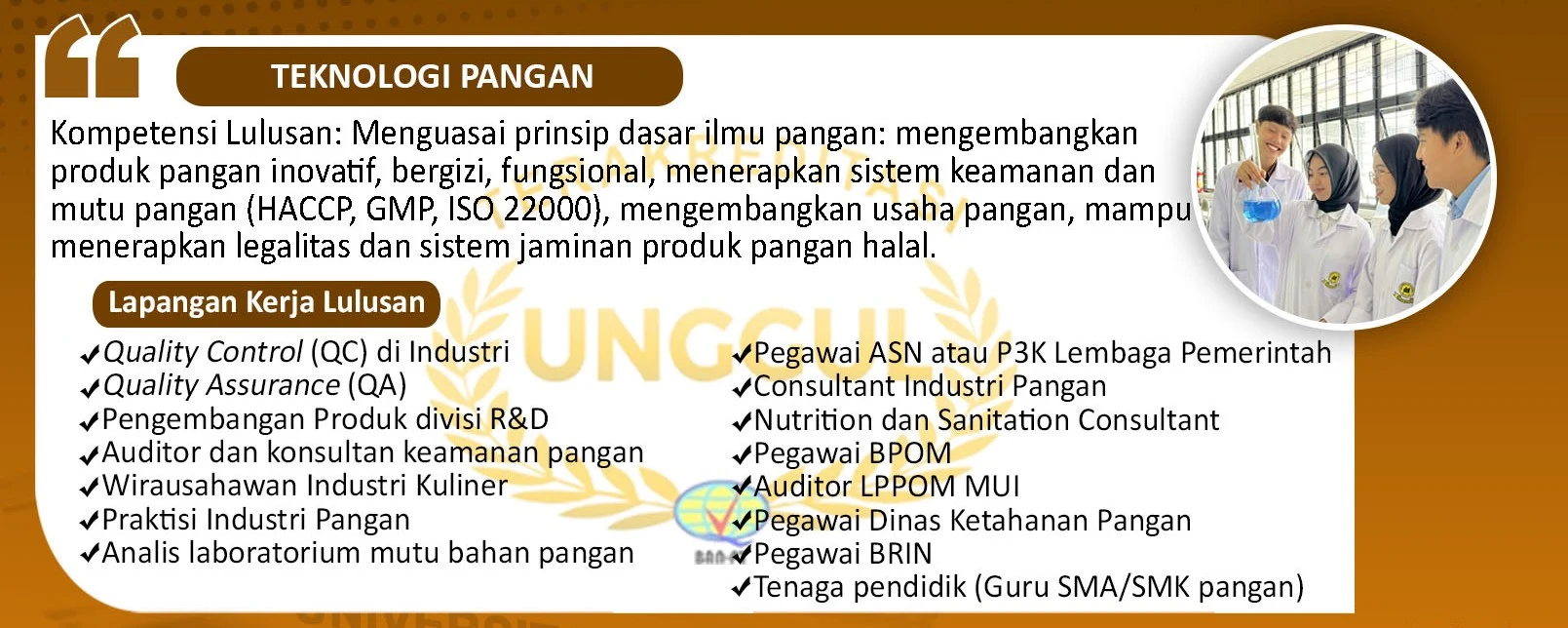
  1. Conducting education in the field of modern and high-quality halal food technology programs
    that meet international standards
  2. Conducting creative and innovative research in the field of halal food technology
    that is beneficial for the development of science, business, and industry
  3. Conducting community service in the field of halal food technology that is
    appropriate and targeted
  4. Conducting program management in the field of halal food technology with proper and correct
    management
  5. Building an integrated campus life in the field of halal food technology that is aligned with
    tauhid
  1. Producing graduates in the field of halal food technology who are monotheistic and globally competitive, supported by modern academic facilities and international standards
  2. Producing research in the field of halal food technology that is oriented towards innovation
    in science, technology, art, and halal and toyyib products that are beneficial
    to society
  3. Producing service in the field of halal food technology that is solution-oriented,value-added and improves community welfare
  4. Improving the quality of program management in the field of halal food technology that is
    transparent, accountable, independent, fair, and participatory, rooted in tauhid
  5. Building a culture of tauhid in the field of halal food technology in all academic
    and non-academic activities for the FIPHAL community
  1. The realization of a food technology graduate program that is unified and globally competitive
  2. Improved quality of learning facilities and infrastructure, laboratories, and galleries showcasing modern, internationally-standard food technology products developed by the campus
  3. The realization of students who excel in both academic and non-academic fields at the international level
  4. The availability of collaborations in the field of food technology with domestic and international institutions in the areas of education, research, and community service
  5. The creation of a conducive and harmonious academic environment
  6. The achievement of publications, citations, intellectual property, prototypes, industrial system design models, as well as halal and toyyib products in the field of food technology that are beneficial and impactful for society
  7. The realization of the development of the UMKM-scale industrial world in the field of halal agroindustry that supports the achievement of increased university income and community economy
  8. The increase in research and creative products from FIPHAL that are value-added, solution-oriented, and beneficial as community service in the field of halal agroindustry
  9. The realization of the professionalism of lecturers and educational staff in the field of food technology that is superior and exceeds national standards
  10. The realization of a quality assurance system in the field of food technology that is integrated with tauhid, encompassing aspects of transparency, accountability, independence, fairness, participation, and harmony
  11. The realization of an ethical and tauhid-based academic climate in the field of food technology within the university